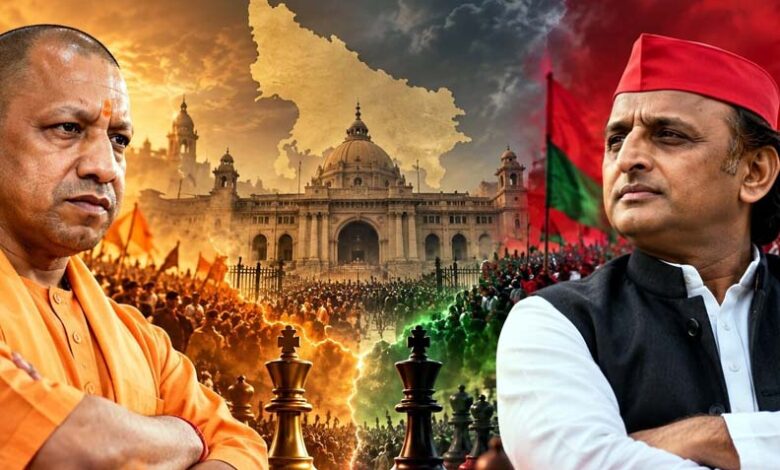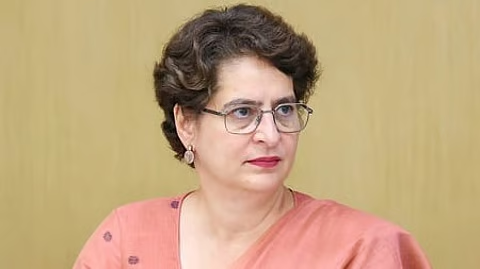
Lucknow: As Uttar Pradesh prepares for the 2027 Assembly elections, Congress faces a major challenge in rebuilding its organisational strength while negotiating an electoral understanding with the Samajwadi Party (SP). With Priyanka Gandhi Vadra entrusted with overseeing the party’s election preparations and alliance discussions, the focus is on whether Congress can establish an independent political presence or will continue to depend on Akhilesh Yadav’s party for electoral gains.
The challenge is particularly significant because Congress’s organisational position in Uttar Pradesh remains considerably weaker than that of the BJP and the Samajwadi Party, despite its improved performance in the 2024 Lok Sabha elections.
On November 3, Priyanka Gandhi held a meeting with senior Uttar Pradesh Congress leaders to discuss organisational preparations, election committees, campaigning and possible seat-sharing arrangements with the SP. Further discussions are expected after Diwali.
The party is also preparing to organise rallies across Uttar Pradesh on the issue of alleged ‘vote theft’ after November 20. However, neither the locations and dates of these rallies nor a final seat-sharing arrangement with the SP have been announced.
Congress’s electoral record raises questions
Priyanka Gandhi’s return to the centre of Uttar Pradesh’s electoral preparations has revived expectations within Congress. However, the party’s previous electoral performances under her leadership offer a mixed picture.
In 2019, Priyanka was given responsibility for eastern Uttar Pradesh ahead of the Lok Sabha elections. Congress managed to win only one of the state’s 80 parliamentary seats, Rae Bareli. Rahul Gandhi also lost Amethi to the BJP.
During the 2022 Assembly elections, Priyanka led a campaign focused heavily on women’s participation, with the slogan ‘Ladki Hoon, Lad Sakti Hoon’. Despite an extensive campaign, Congress won just two of the 403 Assembly seats and secured only 2.33 per cent of the vote.
The 2024 Lok Sabha elections provided some relief. Congress contested 17 seats in alliance with the SP and won six, while the SP secured 37 of the 62 seats it contested. Congress’s vote share in Uttar Pradesh was approximately 9.5 per cent.
However, parliamentary elections and Assembly contests involve different political calculations. Local candidates, caste equations, booth management and long-standing voter connections often play a greater role in Assembly elections.
Akhilesh Yadav holds a stronger bargaining position
The SP enters the alliance negotiations from a considerably stronger electoral position.
In the 2022 Assembly elections, the party won 111 seats with a vote share of 32.06 per cent, compared with Congress’s two seats. In the 2024 Lok Sabha elections, the SP emerged as the largest opposition party in Uttar Pradesh with 37 parliamentary seats.
This gives Akhilesh Yadav considerable leverage in deciding the terms of a possible alliance.
Congress’s reported interest in contesting around 125 seats, along with discussions around a list of approximately 175 constituencies, has raised questions about the basis of its seat-sharing demands.
The key consideration should be the actual winning potential of candidates rather than the number of constituencies the party wishes to contest.
An Assembly-segment analysis of the 2024 Lok Sabha results may provide useful indicators, but finishing second in a constituency does not automatically make a party a strong contender. Previous Assembly results, booth-level support, candidate acceptability and the strength of the SP’s local organisation will all need to be assessed.
Regional political equations pose different challenges
Congress faces different organisational and electoral challenges across Uttar Pradesh.
In western Uttar Pradesh, the political equations involving farmers, Jat voters, Muslims and local leadership will influence candidate selection and alliance negotiations.
In Awadh, the SP’s established organisational network could limit Congress’s bargaining space. In Bundelkhand, Congress will need to identify influential candidates and rebuild its grassroots presence.

Eastern Uttar Pradesh presents another challenge, with caste alignments, regional political leaders and the BJP’s organisational strength likely to shape the contest.
For Congress, the immediate priority is to establish whether it has active district units, credible candidates and trained booth-level workers across the constituencies it wants to contest.
The party also needs to address factionalism, inactive organisational units and internal competition for election tickets. Without these changes, political meetings and campaign announcements may generate publicity without creating a viable electoral structure.
2017 alliance offers lessons for Congress and SP
The previous Congress-SP alliance in the 2017 Assembly elections offers an important lesson.
Despite an extensive joint campaign and a common political message, the SP won 47 seats while Congress secured only seven. Differences in local support and the inability of some sections of their respective voter bases to fully accept alliance candidates affected the partnership.
The two parties will need to ensure better coordination in 2027. If their supporters do not accept candidates fielded by the other alliance partner, the BJP could benefit from divided opposition votes.
The BJP remains a formidable electoral force. In the 2022 Assembly elections, it won 255 seats with a vote share of 41.29 per cent. Its extensive booth-level network, financial resources, leadership structure and advantage of incumbency give it a strong starting position.
The opposition will therefore need to offer voters credible alternatives on employment, inflation, recruitment examinations, farmers’ concerns, women’s safety, education and healthcare.
Allegations of vote theft may become a campaign issue, but voters will also expect political parties to explain how their everyday concerns will be addressed.
Priyanka faces a dual responsibility
Priyanka Gandhi’s challenge is twofold. She must strengthen Congress’s internal organisation while presenting a realistic seat-sharing proposal to Akhilesh Yadav.
Demanding more constituencies than the party can effectively contest could complicate negotiations. On the other hand, accepting a limited number of seats without demonstrating its own political strength could weaken the morale of Congress workers and further reduce the party’s independent identity.
A constituency-wise assessment of winnability, supported by transparent electoral data and organisational performance, could provide a more practical basis for negotiations.
Congress must also decide whether it intends to build an independent political identity in Uttar Pradesh or rely primarily on alliances in successive elections.
The 2024 results demonstrated that an alliance with the SP could improve Congress’s electoral prospects. However, an improved result in a coalition does not automatically indicate a revival of the party’s independent organisational strength.
With Rahul Gandhi assigning Priyanka a central role in the state’s electoral preparations, expectations within Congress are high. Her performance will ultimately be judged by the party’s ability to identify competitive candidates, strengthen booth-level networks and negotiate seats where it has a genuine chance of winning.
Akhilesh Yadav, meanwhile, is likely to approach the negotiations primarily from the perspective of electoral advantage.
The real measure of Congress’s political strength in the 2027 Uttar Pradesh elections will not be the number of seats it demands, but the number of constituencies where it can mount a credible challenge to the BJP and emerge as a serious electoral contender.











 https://www.youtube.com/watch?si=RtToJsBhYBatUrym&v=mOuYNSdhjHA&feature=youtu.be